
SUBSCRIBE TO OUR FREE MONTHLY PROPERTY UPDATE REPORT
Housing market holds steady as global tensions weigh on confidence
New Zealand’s housing market remained resilient through March, with buyers continuing to transact despite the onset of the Iran conflict and a sharp rise in petrol prices.
Data released today by the Real Estate Institute of New Zealand (REINZ) in its Property Report for March 2026 shows sales activity was essentially unchanged year-on-year, while prices remained broadly stable – a result that reflects a market absorbing a global shock rather than retreating from it.
Every transaction captured in the March data was made during the first full month of the conflict, as fuel prices climbed above $3.30 per litre and consumer confidence fell sharply. Despite this, buyers remained active across much of the country.
“March shows a housing market holding its nerve. Despite rising fuel costs and global uncertainty, buyers didn’t step away, but they are becoming more cautious and taking longer to make decisions,” REINZ Chief Executive, Lizzy Ryley, said.
“That caution is reflected in the numbers. Sales were essentially flat year-on-year at 7,853, and while prices remain stable, the seasonally adjusted figures show a slight dip in activity. It suggests buyers are still active, but are more measured, responding to cost pressures rather than stepping away from the market,” she said.
Nationally, the figures point to a market that remains stable, but not uniform. The median price eased slightly by 0.3% year-on-year to $788,000, while excluding Auckland, median prices increased by 1.4% to $710,000 – highlighting continued strength across parts of the country.
While headline numbers appear steady, seasonally adjusted figures indicate a modest softening in underlying demand compared with February, consistent with a more cautious buyer environment.
Performance across the country continues to vary by region, reinforcing the uneven nature of the current market. Eleven of the sixteen regions recorded year-on-year increases in median prices, led by Southland (+11.8%), Nelson (+9.2%) and Northland (+8.7%), while Wellington and parts of the East Coast recorded softer results.
Time to sell remained steady in March, with properties taking a median of 41 days nationally – unchanged from a year ago but 15 days faster than February. Excluding Auckland, the median was also 41 days, down 14 days month-on-month, reflecting a return to more typical seasonal conditions rather than a shift in underlying demand.
Supply levels showed little change. New listings* increased just 0.2% year-on-year to 12,055, while excluding Auckland, there was no year-on-year change, with 5,513 new listings. National inventory levels* rose modestly by 2.1% from last year to 37,638 properties, reinforcing that there has been no significant lift in sellers entering the market despite recent global uncertainty.
Auctions continue to play a key role in some regions, particularly Auckland, Bay of Plenty and Canterbury. Nationally, 1,266 properties were sold at auction, accounting for 16.1% of all sales. In Auckland, nearly one in three properties (29.6%) were sold by auction, compared with 9.9% across the rest of the country.
The House Price Index (HPI), which provides a more accurate measure of underlying value trends, eased slightly over the month to 3,641 and remains 14.9% below its peak. However, regional performance continues to diverge. Otago reached a new record high HPI of 4,318, up 3.6% over the past year, while Canterbury sits just 0.03% below its peak – highlighting the strength of South Island markets, which have largely recovered from the 2022–23 downturn, while other parts of the country continue to rebuild more gradually.
“The Reserve Bank holding the OCR at 2.25% has provided a level of stability for the market, but there is still uncertainty ahead. While we haven’t yet seen a significant impact from global events in the data, agents across the country report that buyers became more cautious toward the end of March,” Lizzy Ryley said
“The focus now shifts to what happens next. Any early signs of a ceasefire have been overshadowed by renewed tensions, leaving uncertainty around fuel costs for New Zealand households and whether confidence begins to rebuild over the coming months,” Ryley says.
*Inventory and Listings data courtesy of realestate.co.nz
Group Account Director, Wright Communications
What will happen to house prices in 2026?
Published: 2:36 pm on 2 January 2026
Susan Edmunds, Money Correspondent susan.edmunds@rnz.co.nz
Photo: RNZ / REECE BAKER
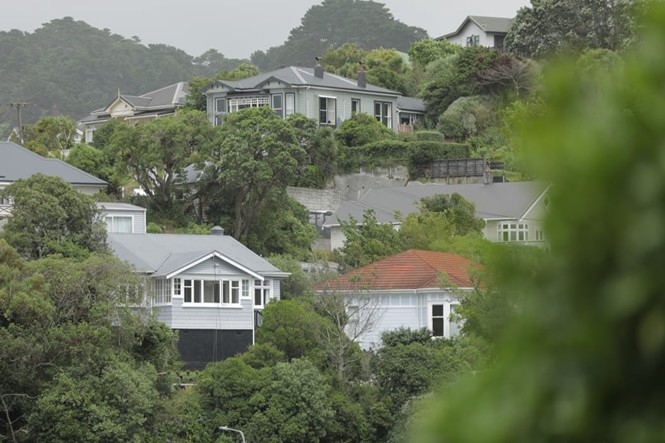 2025 was not a great year for many house price forecasters, who had to revise their forecasts down many times as the year went on.
At the start of the year, Westpac thought prices might lift 7 percent. At one-point ASB thought they could lift 10 percent.
But while activity picked up over the past 12 months, prices were mostly flat and even went through months of decline in the middle of the year.
So what might lie ahead in the coming 12 months?
Commentators say there is likely to be a bit of an increase in prices in the year ahead, but this time no one expects increases anywhere near double-digit percentages.
BNZ chief economist Mike Jones said house prices might rise 4 percent over 2026, about the same as the Reserve Bank’s forecast.
“We’ve had three years in which house prices basically went sideways – we think the trend will bend upwards.”
But he said that increase would be below the average increase of earlier years and there was a chance that the lift could be smaller than 4 percent.
Turnover was back to healthy levels, he said.
“When we stack up the demand factors for next year, they’re all pretty positive – you’ve got the economy defrosting, which tends to coincide with a bit more housing market activity, you’ve got population growth which will probably pick up a bit… And mortgage rates may not go a lot lower, but they’re going to stay relatively low and at levels that will support a bit more housing investment.
“So, I think when you line up those demand factors, we will see activity continuing to recover. It’s just on the house price front, the big uncertainty, the big question is what happens to supply and that’s been the real story of the last couple of years.
“Even though you’ve got lower mortgage rates and more demand, you’ve had more transactions coming through, that’s been more than offset by listings and growth in supply. We may be in the same position next year where we’ve just continued to see supply match up pretty well with demand and there hasn’t been much of a change in house prices.”
Kelvin Davidson, chief economist at property data firm Cotality, said 4 percent or 5 percent seemed a likely increase.
“Some of the things that have been restraining house prices – affordability, lots of listings, slowish pass through of lower mortgage rates, a weak economy, weak labour market – some of those things seem to be turning around now. Affordability is back to normal, interest rates are passing through a lot more, the economy is starting to turn around and listings have come down a bit. The conditions are definitely in place for growth in property values next year.”
But he said things like debt-to-income ratios would limit growth and there was still a strong supply of houses being built.
PROPERTIES FOR SALE BY TEAM DAVIS IN WHANGAREI
GET A FREE PROPERTY APPRAISAL WITH TEAM DAVIS IN WHANGAREI